|
|
|
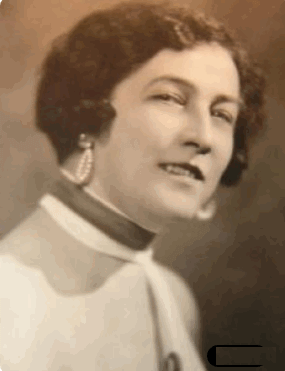
Bliss, Lillie P. 1864-1931
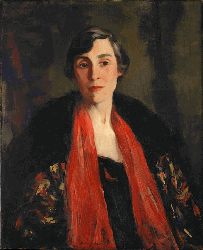
Born Lizzie Plummer Bliss, April 11, 1864 in Boston; died March 12, 1931 in New York City. She was an American art collector and patron. At the beginning of the 20th century, she was one of the leading collectors of modern art in New York. One of the lenders to the landmark Armory Show in 1913, she also contributed to other exhibitions concerned with raising public awareness of modern art. In 1929, she played an essential role in the founding of the Museum of Modern Art. After her death, 150 works of art from her collection served as a foundation to the museum and formed the basis of the in-house collection. These included works by artists such as Paul Cézanne, Georges Seurat, Paul Gauguin, Henri Matisse, Pablo Picasso and Amedeo Modigliani.
|
|
|
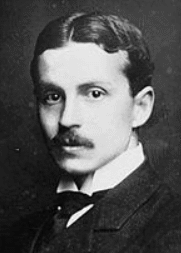
Coburn, Charles Douville 1877 – 1961 (Wife: Ivah Wills Coburn)
Coburn was an American film and theater actor. Best known for his work in comedies, Coburn received the Academy Award for Best Supporting Actor for 1943's The More the Merrier.
Coburn was born in Macon, Georgia, the son of Scots-Irish Americans Emma Louise Sprigman and Moses Douville Coburn. Growing up in Savannah, he started out at age 14 doing odd jobs at the local Savannah Theater, handing out programs, ushering, or being the doorman. By age 17 or 18, he was the theater manager. he later became an actor, making his debut on Broadway in 1901. Coburn formed an acting company with actress Ivah Wills Coburn in 1905. They married in 1906. In addition to managing the company, the couple performed frequently on Broadway.
After his wife's death in 1937, Coburn relocated to Los Angeles, California and began film work. He won an Academy Award for Best Supporting Actor for his role as a retired millionaire playing Cupid in The More the Merrier in 1943. He was also nominated for The Devil and Miss Jones in 1941 and The Green Years in 1946. Other notable film credits include Of Human Hearts (1938), The Lady Eve (1941), Kings Row (1942), The Constant Nymph (1943), Heaven Can Wait (1943), Wilson (1944), Impact (1949), The Paradine Case (1947), Everybody Does It (1950), Has Anybody Seen My Gal? (1952), Gentlemen Prefer Blondes (1953) and John Paul Jones (1959). He usually played comedic parts, but Kings Row and Wilson were dramatic parts, showing his versatility.
For his contributions to motion pictures, Coburn has a star on the Hollywood Walk of Fame at 6240 Hollywood Boulevard.
|
|
|
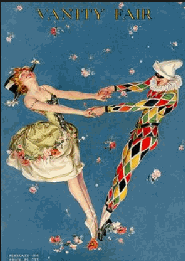
Crowninshield, Francis Welch 1864-1931
Crowninshield, better known as Frank or Crownie, was an American journalist and art and theatre critic best known for developing and editing the magazine Vanity Fair for 21 years, making it a pre-eminent literary journal.
|
|
|
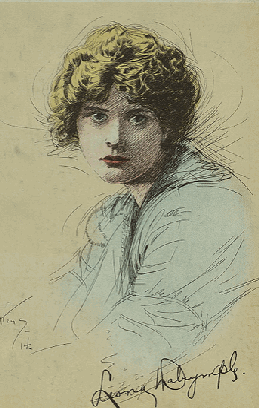
Dalrymple, Leona 1884-1965
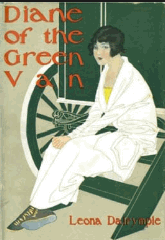
Leona Dalrymple (Mrs. C. Acton Wilson) was an American author. In 1914, she won a prize of $10,000 for her novel, Diane of the Green Van. Among her other stories are Traumerei (1912); The lovable Meddler (1915); Jimsy, The Christmas Kid (1915); She also wrote short stories for magazines and moving picture scenarios.
Books: Diane of the Green Van
Movies: Dangerous Number
|
|
|
Dodge, Mabel 1879-1962
Mabel Evans Dodge Sterne Luhan (pronounced LOO-hahn), née Ganson was a wealthy American patron of the arts. She is particularly associated with the Taos art colony.
Early life:
Mabel Ganson was the heiress of a wealthy banker from Buffalo, New York. She was the daughter of Charles Ganson and Sarah Cook. She was raised to charm and groomed to marry. She grew up in Buffalo’s social elite and was raised in the company of her nursemaid. She had attended Saint Margaret’s Episcopal School for girls until she was sixteen, then went to a school in New York City. In 1896 she toured Europe and went to a finishing school in Washington, D.C., called the Chevy Chase.
Her first marriage, at the age of 21, was to Karl Evans, the son of a steamship owner in 1900. They were married in secret because Charles Ganson did not approve of Evans. They were later re-married in Trinity church in front of all Buffalo Society. They had one son, and Karl died in a hunting accident two-and-half years later leaving her a widow at the age of 23. In the Spring of 1904, an oval portrait of her in mourning dress was painted by the Swiss-born American artist Adolfo Müller-Ury for her paternal grandmother Nancy Ganson of Delaware Avenue in Buffalo. Her family sent her to Paris because she was having an affair with a prominent Buffalo gynecologist. Later that year she married Edwin Dodge, a wealthy architect.
She was actively bisexual during her early life and frankly details her passionate physical encounters with young women in her autobiography Intimate Memories (1933)
Florence:
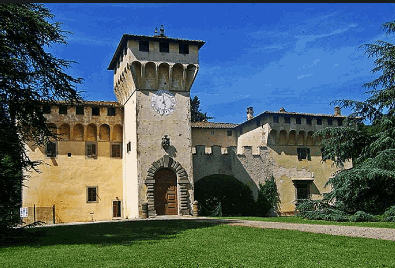
The Dodges lived in Florence from 1905 to 1912. At her palatial Medici villa—the Villa Curonia in Arcetri, not far from Florence—she entertained local artists, as well as Gertrude Stein, her brother Leo, Alice B. Toklas, and other visitors from Paris, including André Gide. A troubled liaison with her chauffeur led to two suicide attempts: the first was by eating figs with shards of glass; the second with laudanum.
New York and Provincetown:
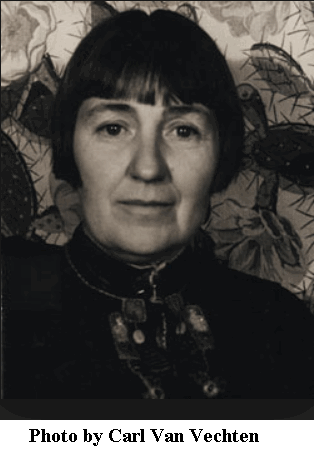
In mid-1912, the Dodges (who by this time were becoming estranged) returned to America, and she began to set herself up as a patron of the arts, holding a weekly salon in her new apartment at 23 Fifth Avenue in Greenwich Village. Often in attendance were such luminaries as Carl Van Vechten, Margaret Sanger, Emma Goldman, Charles Demuth, "Big Bill" Haywood, Max Eastman, Lincoln Steffens, Hutchins Hapgood, Neith Boyce, Walter Lippmann, and John Reed. Van Vechten took Dodge as the model for the character "Edith Dale" in his novel Peter Whiffle. Anthropologist Raymond Harrington introduced Dodge and her friends to peyote in an impromptu "ceremony" there.
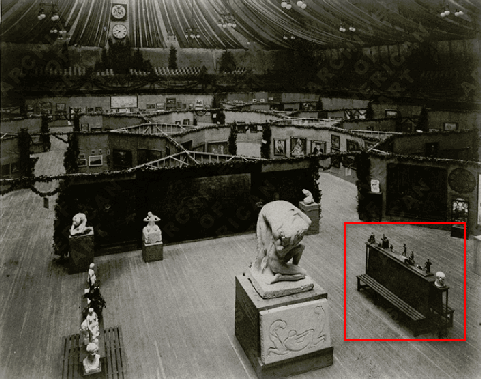
She was involved in mounting the Armory Show of new European Modern Art in 1913, and she published in pamphlet form a piece by Gertrude Stein, "Portrait of Mabel Dodge at the Villa Curonia", which Dodge distributed at the exhibition. This brought her public attention.
She sailed to Europe at the end of June 1913. Her new acquaintance John Reed (Jack)—worn out from having recently organized the Paterson Pageant—travelled with her. They became lovers after arriving in Paris, where they socialized with Stein and Pablo Picasso. They moved down to the Villa Curonia, where the guests this time included Arthur Rubinstein. At first this was a very happy time for the couple, but then tension grew between the two as Reed grew uncomfortable with the affluent isolation and Dodge saw his interests in the world of people and achievements as a rejection of her. They returned to New York in late September 1913. In October 1913 Reed was sent to report on the Mexican Revolution by Metropolitan Magazine. Dodge followed him to Presidio, a border town, but left after a few days. In 1915, she returned to Provincetown with painter Maurice Sterne.
Over 1914–16 a deep and continuing relationship developed between the intelligentsia of Greenwich Village and Provincetown. Reed contributed to the start of the Provincetown Players, and Dodge had a rivalry with Mary Heaton Vorse.
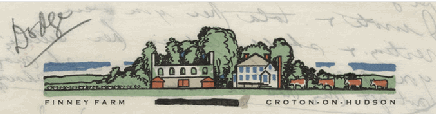
Dodge became a nationally syndicated columnist for the Hearst organization. She moved to Finney Farm, a large Croton estate. Sterne, who was to become Dodge's third husband, was staying in a cottage behind the main house. Dodge offered Reed the third floor of the house as a writing studio; he moved in for a short period, but the situation was untenable. Later that year, 1916, Dodge married Sterne.
Around this time Dodge spent a great deal of time living in Santa Barbara, California, where her friend Lincoln Steffens had relatives who were living at the time. Lincoln Steffens' sister Lottie was married to local rancher John J. Hollister.
Taos:
In 1919 Dodge, her husband, and Elsie Clews Parsons moved to Taos, New Mexico, and started a literary colony there. On the advice of Tony Luhan, a Native American whom she would marry in 1923, she bought a 12-acre (49,000 m2) property. Luhan set up a teepee in front of the small house and drummed there each night until Dodge came to him. Sterne bought a shotgun with the intention of chasing Luhan off the property, but he was unable to use it, and took to insulting Dodge. In response, she sent Sterne away, supporting him with monthly payments until their divorce four years later.
D. H. Lawrence, the English author, accepted an invitation from her to stay in Taos and he arrived, with Frieda his wife, in early September 1922. He had a fraught relationship with his hostess and wrote about this in his fiction. Dodge later published a memoir about his visit entitled, Lorenzo in Taos (1932).
Dodge and Luhan hosted a number of influential artists and poets including Marsden Hartley, Arnold Ronnebeck, Louise Emerson Ronnebeck, Ansel Adams, Willa Cather, Robinson Jeffers and his wife Una, Florence McClung, Georgia O'Keeffe, Mary Hunter Austin, Frank Waters, Jaime de Angulo, and others.
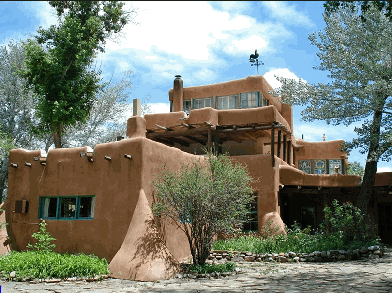
Dodge died at her home in Taos in 1962 and was buried in Kit Carson Cemetery. The Mabel Dodge Luhan House has been designated a National Historic Landmark and is an historic inn and conference center. Natalie Goldberg frequently teaches at Mabel Dodge Luhan House, which Dennis Hopper bought after seeing it while filming Easy Rider.
Archives:
The Mabel Dodge Luhan Papers Collection—a collection of letters, manuscripts, photographs and personal papers documenting Dodge's life and works—is housed at the Beinecke Library at Yale University. A portion of the collection is available online.
|
|
|
Greene, Belle da Costa 1879-1950
She was born Belle Marion Greener in Washington, D.C., and grew up there and in New York City. Her biographer Heidi Ardizzone lists Greene's birth date as November 26, 1879. Her mother was Genevieve Ida Fleet, a member of a well-known African American family in the nation's capital, while her father was Richard Theodore Greener, an attorney who served as dean of the Howard University School of Law and was the first black student and first black graduate of Harvard (class of 1870). After his separation from his wife (they never divorced), Greener became a U.S. diplomat posted to Siberia, where he had a second family with a Japanese woman. Once Greene took the job with Morgan, she likely never spoke to her father again. She may have met him once in Chicago around 1913, but there are no letters or written proof. She burned all personal papers in her possession shortly before her death, while Richard was thought to have lost most of his in the 1906 San Francisco earthquake. A recent treasure trove of documents belonging to Greener was discovered in the attic of an abandoned house in Chicago, however, and early indications are that they will shed even greater light on Greener's life.
After her parents' separation, the light-skinned Belle, her mother, and her siblings passed as white and changed their surname to Greene to distance themselves from their father. Her mother changed her maiden name to Van Vliet, apparently in an effort to assume Dutch ancestry, while Belle dropped her middle name in favor of da Costa and began claiming a Portuguese background to explain her dusky complexion. Eventually, she moved to Princeton, New Jersey, where she worked at the Princeton University Library.
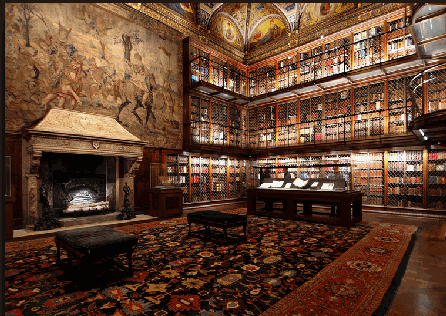
The financier J. P. Morgan had in 1902 engaged Charles F. McKim to build him a library to the east of his Madison Avenue brownstone as his collection already was too large for his study. To manage his collection he hired Greene as his personal librarian in 1905, having been introduced to her by his nephew, Junius, a Princeton student. Soon trusted for her expertise (she was an expert in illuminated manuscripts) as well as her bargaining prowess with dealers, Greene would spend millions of dollars not only buying but selling rare manuscripts, books and art. She has been described as smart and outspoken as well as beautiful and sensual. While she enjoyed a Bohemian freedom, she was also able to move with ease in elite society, known for her exotic looks and designer wardrobe. "Just because I am a librarian," Greene reportedly announced, "doesn't mean I have to dress like one."
Not only did her bearing, style, and seemingly unlimited means attract notice, but "her role at the Morgan Library placed her at the center of the art trade and her friendship was coveted by every dealer." The power that she wielded for 43 years was unmatched. She told Morgan - who was willing to pay any price for important works - that her goal was to make his library "pre-eminent, especially for incunabula, manuscripts, bindings, and the classics."
J. P. Morgan left her $50,000 in his will, which at that time was a significant sum, reportedly $800,000 in modern money. Asked if she was Morgan's mistress, she is said to have replied, "We tried!" She never married, however, and her most lasting romantic relationship was with the Renaissance Italian art expert Bernard Berenson.
Greene retired in 1948 and died in New York City two years later
|
|
|
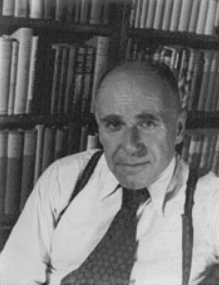
Hapgood, Hutchins 1869-1944
Born May 21, 1869 in Chicago and died November 19, 1944 in Provincetown, Maine, Hutchins Hapgood was an American journalist, author and anarchist.
Hapgood grew up in Alton, IL, where his father was a wealthy manufacturer of farming equipment. After a year at the University of Michigan, he transferred to Harvard University, where he took a B.A. in 1892 and earned his Masters in 1897. Two of the intervening years were spent studying sociology and philosophy at the universities of Berlin and Freiburg, Germany. At first, he became a teacher of English composition at Harvard and the University of Chicago, but was eventually inspired by his older brother, Norman to pursue a career in journalism.
He obtained his first employment with the New York Commercial Advertiser (later known as the New York Globe). His mentor there was Lincoln Steffens, the muckraking reporter. On June 22, 1899, he married Neith Boyce, Steffens' assistant. In 1904, when the Advertiser was revamped as the Globe, he went back to Chicago for a time and became the drama critic for the Chicago Evening Post. Returning to New York, he spent much of his career as an editorial writer for the New York Evening Post, the Press, and the Globe.
Following the deaths of his father in 1917 and his eldest son Boyce (in the 1918 flu epidemic), Hapgood's career began to decline. A few years later, general disillusionment over the decadence of the post-war world led him to retire. Hapgood died on November 19, 1944, in Provincetown, and was buried in the family plot in East Cemetery, Petersham, Massachusetts.
Works:
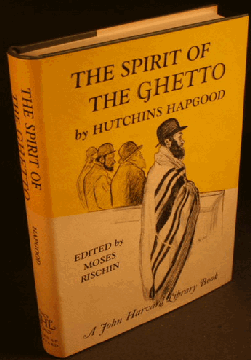
* The Spirit of the Ghetto: Studies of the Jewish Quarter in New York (1902, reissued by Belknap Press, 1983. ISBN 0-674-83266-3)
* Autobiography of a Thief (1903)
* The Spirit of Labor (1907, reissued by the University of Illinois Press, 2004. ISBN 0-252-07187-5)
* Types from City Streets (1910, reissued by Garret Press, 1970. ISBN 0-512-00759-4)
* An Anarchist Woman (Novel, 1909)
* The Story of a Lover (1919) Published anonymously. A frank account of his open marriage.
* A Victorian in the Modern World (Autobiography, 1939, reissued by the University of Washington Press, 1972: ISBN 0-295-95183-4)
|
|
|